One of the Wesleyan theological bloggers I regularly follow is Craig Adams. I really identified with this blog post: Toward a Theology of Levity. Check it out!
Toward a Theology of Levity | Theology | Commonplace Holiness
About Me

- Dayton D. Mix
- Clarks Mills, Pennsylvania, United States
- I'm a husband, a dad, a son, a grandson, a pastor, & now a grandpa, too! Those are the basic hats I wear in my daily life. I was born & raised in rural Pennsylvania couple of miles from the New York border in a small town, Shinglehouse (Potter County). I struggle with my weight & my own quirks just like everyone else does. I became a United Methodist pastor in 1996 and was ordained in 2003. While I'm officially Methodist, I also consider myself a “charismatic” Christian, as well as an “evangelical”, although not everything identified with either of those labels fits me perfectly. I enjoy genealogy but seldom have time to do much with it. I like playing with eBay. I like to read, watch movies, camp, hike, and talk. I LOVE to write, but usually don't worry too much about formal grammar... instead choosing to write as I probably would speak. And even though I can spell pretty well, I'm a lousy typist, so be gracious. I update my blogs as often as I can, but I have a real life that demands me NOT being at the computer all the time... so there are dry spells!
Showing posts with label Methodist. Show all posts
Showing posts with label Methodist. Show all posts
Friday, May 04, 2012


Friday, May 20, 2011
What is United Methodism?
In 2001, in Patton, PA, most of the town's churches (Protestant and Catholic) gathered during Lent, as they had done for years prior. But this year, 2001, the pastors agreed to them their 'devotional' message (given on the week their congregation served the soup & sandwich supper) around the beliefs and traditions of their Church. These are essentially my notes from that night 10 years ago. The only changes were spelling and grammar.
So… What makes us United Methodists unique?
You see, in the early part of the 1700s, an Oxford student named John Wesley and his brother Charles, were part of a small group of college buddies that got together regularly to pray, read the Bible, and encourage one another in their Christian walk.
Their intent was to help each other be obedient to the Biblical command that called for holiness and holy living from the people of God.
And they knew that alone they were going to mess it up. The church of their day was filled with priests and people who simply went through the motions of religion when they were in church services and lived like the devil all the rest of the week.
So these young men banded together to try and help each other face the temptations and the distractions so that they might be “holy unto the Lord.”
They believed a set pattern of consistently immersing themselves in God's Word was needed if they were going to be Christian. They also felt that Jesus' instructions about feeding the hungry, clothing the naked, visiting the prisoners, were to be taken seriously… and that we as Christians ought to be about Jesus' business in those areas.
At one point, they called their group a “holy club.” Other students laughed at them and called them names like “method--ists.”
The name stuck, and Methodist to this day is a good description of what this denomination of Christians believes.
We believe that we must be INTENTIONAL about following Jesus Christ. You can't simply be baptized and then never acknowledge Christ again. You can't simply claim to have “accepted Jesus” and then live like the devil from then on. You can't simply go to church and figure you've made it into Heaven.
The analogy of a newborn baby fits pretty well here. Just like a baby has quite a bit of time between conception and its birth, so Methodism teaches that God's grace is poured out on us even before we are “spiritually born” and that the church, like the mother of that baby in the womb, has a role in caring and nurturing the yet unborn child of God.
In the same way that the baby in the womb eventually reaches a critical moment when the mother's water breaks and the baby is born, so Methodism teaches that there will be a critical moment where each of us will be “born again,” consciously deciding to allow Christ to be our Lord, our Savior, our source of hope and life. The difference lies in the fact that as humans, we have a choice as to whether we will be born in spiritual birth.
Likewise, just as parents of that newborn baby must then spend years feeding and caring for the helpless baby, Methodism teaches that we must care for the spiritual babes, and discipleship and training are hallmarks of Methodism.
But Methodism also recognizes that that physical child will never be able to quit feeding on physical food and caring for his or her physical body, and in Methodism we find a belief that we, as maturing Christians, can never be satisfied with our past history of being a Christian, but must be intentional about regularly feeding on Gods' Word, serving Him, gathering together with His people, and talking and listening to Him in prayer.
So far, we could probably be almost any church group represented here… and that's part of the message of Methodism. Wesley never intended to make a new church denomination. Methodists were a small group accountability, discipleship and evangelism movement WITHIN the regular church that its members already belonged to… the Anglican Church.
You would go church on Sunday at the Anglican Church, receive communion, be faithful to the church, you would have been baptized there and there you go to receive Holy Communion.
But then, sometime during the week, a Methodist would then gather at a Methodist meeting and study the Bible, pray together, and ask each other nosy, penetrating questions like `What sins have you committed this week that you need to repent of?' and ‘How is it with your soul?’
Methodism was an accountability group… in fact, if you covenanted with these people to be a “Methodist” then you HAD to pay a set apportioned amount into the group coffers to be able to help pay for the ministries of reaching out to the poor with food and clothing. And if you covenanted with these people to be a “Methodist” you HAD TO be present each week. You miss more than a couple of times (without being sick or something) you were kicked out of the Methodist Society.
In fact, it wasn't until the American Revolution, when the Anglican priests were called back to England, that John Wesley finally consented to actually having “ordained” pastors in American Methodism. In so doing, the preachers, which had simply been lay ministers, were now able to become ordained and thus, able to officiate over the Sacraments of Baptism and Holy Communion.
The new American brand of Methodism, in 1784, was called the Methodist Episcopal Church, meaning we were Methodist in our beliefs and episcopal in our structure. (The word 'episcopal' means led by a bishop.) Today we are known as United Methodists, because the Methodists have united with others of similar beliefs through the years.
Methodism really is a lot like almost all other churches. Especially the Anglican Church and its American brothers and sisters, the Episcopal Church. Methodists and Anglicans both come out of the Anglican Church and our views on so many things are similar. We work together well.
Methodism shares a heritage with Catholicism, Roman and Byzantine, for it was Wesley's reading and consuming the works of church writers from both realms that helped influence his formulation of what it meant to be a Methodist. And we, like they, to this day find bishops discerning where its pastors will be best used in ministry settings.
Methodism shares a heritage with the Presbyterian's Calvinistic background. Wesley found he could agree with many of the ideas Calvin put forth about heaven and hell… although Wesley stressed that WE the individuals had free will to respond to God's outpoured grace.
Methodism then and now, believes strongly in the idea that EVERY believer in Jesus Christ is a minister. Agreed, some of those believer/ministers are called to some extra tasks in the church as ordained pastors, but the ministry of evangelism, nurture, outreach, and witness, is the role of EVERY Methodist.
The annual conference, made up of all the pastors and all the local churches in an area, sends pastors on a rotating basis, to help train and equip the saints in doing those various ministries. Sunday morning, to a Methodist, is supposed to be a weekly re-equipping time for them as a minister.
In fact, in Methodism, the highest a pastor can hope to go is to become an `elder', which in most denominations is simply a layperson who is in charge of leadership in the church… And as pastors, our highest call and greatest recognition is simply as one of the “everyday believers...” who has a specialized ministry.
The final hallmark of Methodism is again something set in motion by John Wesley himself when he said "I am a man of only one book." In reality, he read A LOT of books, but only one, the Bible, could be used as the reliable, authoritative source of knowing about God. Today, our primary source of knowledge and belief is still the Bible. Sure we use our reason, our experience, and our heritage to help us make sense of the Bible and how it can be applied to us today, but the Holy Scriptures are where we always start.
John Wesley, when answering a question about "What is a Methodist?" responded that a Methodist was simply a Christian who had the love of God in his heart.
= = = = = = = = = = = = = = = = = = = = = =
DAYTON'S NOTES for Lenten Supper March 27, 2001What is United Methodism?
So… What makes us United Methodists unique?
You see, in the early part of the 1700s, an Oxford student named John Wesley and his brother Charles, were part of a small group of college buddies that got together regularly to pray, read the Bible, and encourage one another in their Christian walk.
Their intent was to help each other be obedient to the Biblical command that called for holiness and holy living from the people of God.
And they knew that alone they were going to mess it up. The church of their day was filled with priests and people who simply went through the motions of religion when they were in church services and lived like the devil all the rest of the week.
So these young men banded together to try and help each other face the temptations and the distractions so that they might be “holy unto the Lord.”
They believed a set pattern of consistently immersing themselves in God's Word was needed if they were going to be Christian. They also felt that Jesus' instructions about feeding the hungry, clothing the naked, visiting the prisoners, were to be taken seriously… and that we as Christians ought to be about Jesus' business in those areas.
At one point, they called their group a “holy club.” Other students laughed at them and called them names like “method--ists.”
The name stuck, and Methodist to this day is a good description of what this denomination of Christians believes.
We believe that we must be INTENTIONAL about following Jesus Christ. You can't simply be baptized and then never acknowledge Christ again. You can't simply claim to have “accepted Jesus” and then live like the devil from then on. You can't simply go to church and figure you've made it into Heaven.
The analogy of a newborn baby fits pretty well here. Just like a baby has quite a bit of time between conception and its birth, so Methodism teaches that God's grace is poured out on us even before we are “spiritually born” and that the church, like the mother of that baby in the womb, has a role in caring and nurturing the yet unborn child of God.
In the same way that the baby in the womb eventually reaches a critical moment when the mother's water breaks and the baby is born, so Methodism teaches that there will be a critical moment where each of us will be “born again,” consciously deciding to allow Christ to be our Lord, our Savior, our source of hope and life. The difference lies in the fact that as humans, we have a choice as to whether we will be born in spiritual birth.
Likewise, just as parents of that newborn baby must then spend years feeding and caring for the helpless baby, Methodism teaches that we must care for the spiritual babes, and discipleship and training are hallmarks of Methodism.
But Methodism also recognizes that that physical child will never be able to quit feeding on physical food and caring for his or her physical body, and in Methodism we find a belief that we, as maturing Christians, can never be satisfied with our past history of being a Christian, but must be intentional about regularly feeding on Gods' Word, serving Him, gathering together with His people, and talking and listening to Him in prayer.
So far, we could probably be almost any church group represented here… and that's part of the message of Methodism. Wesley never intended to make a new church denomination. Methodists were a small group accountability, discipleship and evangelism movement WITHIN the regular church that its members already belonged to… the Anglican Church.
You would go church on Sunday at the Anglican Church, receive communion, be faithful to the church, you would have been baptized there and there you go to receive Holy Communion.
But then, sometime during the week, a Methodist would then gather at a Methodist meeting and study the Bible, pray together, and ask each other nosy, penetrating questions like `What sins have you committed this week that you need to repent of?' and ‘How is it with your soul?’
Methodism was an accountability group… in fact, if you covenanted with these people to be a “Methodist” then you HAD to pay a set apportioned amount into the group coffers to be able to help pay for the ministries of reaching out to the poor with food and clothing. And if you covenanted with these people to be a “Methodist” you HAD TO be present each week. You miss more than a couple of times (without being sick or something) you were kicked out of the Methodist Society.
In fact, it wasn't until the American Revolution, when the Anglican priests were called back to England, that John Wesley finally consented to actually having “ordained” pastors in American Methodism. In so doing, the preachers, which had simply been lay ministers, were now able to become ordained and thus, able to officiate over the Sacraments of Baptism and Holy Communion.
The new American brand of Methodism, in 1784, was called the Methodist Episcopal Church, meaning we were Methodist in our beliefs and episcopal in our structure. (The word 'episcopal' means led by a bishop.) Today we are known as United Methodists, because the Methodists have united with others of similar beliefs through the years.
Methodism really is a lot like almost all other churches. Especially the Anglican Church and its American brothers and sisters, the Episcopal Church. Methodists and Anglicans both come out of the Anglican Church and our views on so many things are similar. We work together well.
Methodism shares a heritage with Catholicism, Roman and Byzantine, for it was Wesley's reading and consuming the works of church writers from both realms that helped influence his formulation of what it meant to be a Methodist. And we, like they, to this day find bishops discerning where its pastors will be best used in ministry settings.
Methodism shares a heritage with the Presbyterian's Calvinistic background. Wesley found he could agree with many of the ideas Calvin put forth about heaven and hell… although Wesley stressed that WE the individuals had free will to respond to God's outpoured grace.
Methodism then and now, believes strongly in the idea that EVERY believer in Jesus Christ is a minister. Agreed, some of those believer/ministers are called to some extra tasks in the church as ordained pastors, but the ministry of evangelism, nurture, outreach, and witness, is the role of EVERY Methodist.
The annual conference, made up of all the pastors and all the local churches in an area, sends pastors on a rotating basis, to help train and equip the saints in doing those various ministries. Sunday morning, to a Methodist, is supposed to be a weekly re-equipping time for them as a minister.
In fact, in Methodism, the highest a pastor can hope to go is to become an `elder', which in most denominations is simply a layperson who is in charge of leadership in the church… And as pastors, our highest call and greatest recognition is simply as one of the “everyday believers...” who has a specialized ministry.
The final hallmark of Methodism is again something set in motion by John Wesley himself when he said "I am a man of only one book." In reality, he read A LOT of books, but only one, the Bible, could be used as the reliable, authoritative source of knowing about God. Today, our primary source of knowledge and belief is still the Bible. Sure we use our reason, our experience, and our heritage to help us make sense of the Bible and how it can be applied to us today, but the Holy Scriptures are where we always start.
John Wesley, when answering a question about "What is a Methodist?" responded that a Methodist was simply a Christian who had the love of God in his heart.
Monday, January 10, 2011
The Rest of the Story
My notes from my Sunday sermons at Reynoldsville: First UMC yesterday.
First Scripture Reading: Mark 1:4-11
Second Scripture Reading: Acts 19:1-7
- - - - - - - - - - - - -
This morning, we look at a short passage from the book of Acts, where Luke has recorded details impressed upon him as important by the Holy Spirit of God, as he follows the ministry of Paul and the early church. But it’s part of a bigger story…
In the chapter before this, Paul has been on an extended tour, preaching and teaching about how to faithfully live life as a disciple of Jesus Christ. Paul’s travels, in that one chapter alone included stops in Athens, Corinth, Syria, Ephesus, Caesarea, Jerusalem, Antioch, Galatia, and Phrygia… and the Bible says that he “held discussions” (18:4,19), and he was “preaching the message” and “testifying” (18:5), “teaching” (18:11), “greeted the church” (18:22), and “strengthening all the believers” (18:23).
And we know that this took a while, first of all because there were no turnpikes… or airports… or taxis, but also because we know that he spent at least a year and a half in one spot alone, Corinth (18:11).
And in our text this morning, he’s at it again and ends up back in the city of Ephesus, where he had stopped briefly in his last set of travels (18:19-21).
And the first thing Luke tells us… is that Paul gets there to Ephesus… “while Apollos was in Corinth…”
OK… so who’s Apollos… and why do we care that he’s in Corinth when Paul gets to Ephesus?
Well, at the end of the chapter before this, in verse 24, we find that Apollos was a Jew who was “eloquent” when he spoke and had a “thorough knowledge” of the Scriptures.
Verse 25 of chapter 18 then lets us know that he had received instruction in “the Way of the Lord” and was able to teach others the facts about Jesus… correctly in fact.
In fact, he ends up teaching and preaching in Ephesus, where Paul had stopped back in verses 19, 20, and 21, but where Paul had not been able to stay long enough to do any long term explanations or teaching or discipleship.
And here comes Apollos, filling in the gap… teaching what he knows… and doing it really well.
But, the Bible goes on to say that Apollos “knew only the baptism of John.” (18:25)
And then here we are now in chapter 19 with Paul encountering Christians from that very same Ephesus and he finds that they “haven’t heard” that there even was a Holy Spirit, let alone received the Holy Spirit.
They, like Apollos before them, had only received a piece of the story… and had followed the form of what they thought was good religious practice… they were baptized in the way that John the Baptist had done… a baptism of repentance.
Folks, without stepping too deeply into the deep waters of baptismal theology, I think there are a couple of things God might be saying through these verses for you and me as we minister here in this place.
First of all, we, like Apollos and the Ephesian Christians Paul encounters, may have all of the instruction and training about Jesus and still be missing a major piece of the life of a Christian disciple.
The head knowledge about Jesus is good, and it’s a great place to start… that’s why we spend so much time and effort and money in having Sunday Schools… We want our children (and even us as adults) to have the godly, Christ-centered head knowledge to make informed and godly decisions… about salvation, about discipleship, about living in the midst of the world as an ambassador for Christ…
But that’s can’t be where it ends… Like Apollos, it’s not enough to simply be knowledgeable, or even eloquent and convincing…
Luke spends several verses, over the course of two chapters, explaining the difference and the incompleteness of Apollos and these Ephesian Christians who only had the baptism of John… Their baptism was simply a response on their part to symbolize their own repentance… And twice, Scripture emphasizes that that simply isn’t enough…
Christian baptism isn’t just a symbolic representation of your repentance or mine… that became clear when Jesus insisted on John baptizing him… Jesus had nothing to repent of… and John knew it… If you remember, John didn’t want to baptize Jesus and said ‘no Lord, I need you to baptize me…’ Because in John’s mind, baptism was a matter of repentance.
But, as would be the case so often in Christ’s ministry, Jesus turned John’s whole idea of baptism on its head… It could no longer be just about repentance. Jesus refused to baptize John in a baptism of repentance and insisted that John baptize him… and Christian baptism changed from that moment on.
John found out from Jesus, Apollos found out from Aquila and Priscilla, and these Ephesian disciples found out from Paul. Christian baptism doesn’t represent what you and I do or decide…
That’s why we, as United Methodists, don’t get all hung up about baptizing children and infants… because it’s not about their repentance, it’s about God choosing to pour his grace and mercy out on people who were still sinners and don’t deserve the gift of salvation… and yet God chooses them anyways.
And babies, toddlers, children, teens, adults, and even senior citizens all need God’s grace equally… and God pours out his grace on each one… whether they’ve repented yet or not… Baptism is a visible sign of what GOD has already done and is still doing… Offering and grace and mercy to all…
In fact, Scripture teaches that God’s grace is what enables us to even experience the gift of repentance so that we can respond to Christ’s offer of salvation…
Baptism represents God’s grace…
“Well, preacher,” you may be thinking, “I don’t see why this is so important… what difference does it really make anyways?”
Well, enough of a difference that it was included in the Scriptural text as part of the words of God that are for our instruction, doctrine, correction, and training in righteousness. God Himself felt this was important enough to make it into the book…
It makes enough of a difference that the Ephesians were then baptized as Christians in the name of Jesus… because the baptism of repentance simply wasn’t good enough… not for a Christian who had freely experienced the grace of God poured out on him through no effort of his own.
So what do we see here that we can specifically apply, in our day and age, in our situation, in our lives?
First, On this day when we remember Jesus’ baptism, let’s not get baptism and repentance confused… repentance is US recognizing our sin and US choosing to give up that sin. However, baptism is all about what GOD does… not what we do.
Second, let’s take a lesson from Paul, and make sure that we leave people like Aquila and Priscilla, good and mature Christians who can follow up and disciple newer Christians… It’s not enough to have Sunday School training and head knowledge, but rather we want to entrust our young in age and young in faith to people who are living out the Christian walk of faith… and can lead by example as well as by words…
Third, let’s remember that our journey of faith, including our baptism, and also times when we respond to God, are nothing until we allow God to pour out His Holy Spirit on us… filling us and immersing us in His presence and His power through His Spirit.
This morning, I want to encourage each of us to ask ourselves a question…
Where do we find ourselves in these passages?
Are we like these twelve Ephesian disciples? Trying to be faithful, doing all of the right things as best as we can understand them? And yet, still basing our entire Christian walk on our efforts and our decisions and our rational choices and logical understandings?
If so, reach out in prayer to God and allow him to take you beyond mere religious response and fill you with His Spirit… that your life would be a life marked by the outpouring and experience of grace, not merely a religious set of ‘gottas’ and ‘can’ts’ based in your own understanding.
Perhaps, you have already come to that place where you’ve gone beyond the head knowledge and have experienced the power of God being poured out into your life… If so, then according to Scripture there is some gift of the Holy Spirit that He has also given you… for these twelve Ephesians it was tongues and prophesy… Do you know what spiritual gift (or gifts) He gave you when He poured out His Spirit on you?
Finally, are you one who’s experienced the maturing power of God in your life? Then, like Paul, and Aquila and Priscilla, we need you to be reaching out in ministry to those who are still en route… What ministry are you actively involved in… where you are using those spiritual gifts and helping to teach, preach, encourage, or strengthen those younger in the faith like Apollos or the Ephesian disciples?
Can we… WILL we… take that next step?
--Adapted from a sermon I preached Jan. 12, 2003 in Patton, PA
Thursday, December 16, 2010
Wrong Motives, Right Attitude
Yesterday was the day that a devotional I wrote for the Western PA-Germany United Methodist Partnership's Advent Devotional Book was featured. I wrote the English version and one of our German UM's translated it into German.
Wednesday 15th December
Numbers 24: 2 – 7, 15 – 17
Today’s passage records the last of the prophet Balaam’s attempts to earn respect and rewards from the king of the land. All he has to do is pronounce a curse against the children of Israel as they finish their journey towards the promised land. Twice now, Balaam sought an omen that he might use as a curse, but both times Scripture states that "God met with Balaam." (Num 23:4,16). Each of those encounters results not in a curse, but in a blessing. The king is angry and Balaam agrees to try again.
So King Balak waits while Balaam prays, again looking for something he might say to bring a curse on the Israelites and bless King Balak’s forces. But this time, we read in Numbers 24:2, the spirit of God literally comes upon Balaam. What proceeds from the resulting pronouncement is even more than a blessing, it includes a prophetic picture of how God would one day bring the blessing of the coming Messiah upon the earth through these Israelites. Balaam sees the Messiah as the "Star" and a "Scepter" who will ultimately reign over all … even King Balak’s lands and peoples.
In spite of his wrong motives, Balaam was aware that it was a path to utter failure if he misrepresented his God. How about us? In our lives, how well do we represent our God? We claim we know the Messiah and he’s coming again soon. Do people around us see that in our lives, or do we merely represent ourselves and our own ways? This Advent, as we prepare ourslves anew for Christ’s Second Coming, let’s make sure our lives, our actions, and even our words, are such that those around us can see his "Star" rising in our lives.
Dayton D Mix
Pastor First United Methodist Church in Reynoldsville, PA, (USA)
- - - - - - - - - - - - - -
Mittwoch 15. Dezember
4. Mose 24, 2 – 7 + 15 – 17
Die heutige Bibelstelle handelt vom letzten Versuch des Propheten Bileam, Respekt und Belohnung vom König des Landes zu bekommen. Er braucht nur einen Fluch gegen die Kinder Israels am Ende ihrer Reise ins gelobte Land auszusprechen. Zweimal schon hat Bileam einen Spruch gesucht, der ihm als Fluch dienen könnte, aber beides Mal heiβt es in der Schrift, „Und Gott begegnete Bileam.“ (4. Mose 23, 4,16). Jede dieser Begegnungen führt nicht zu einem Fluch, sondern zu einem Segen. Der König ärgert sich und Bileam ist bereit, es aufs Neue zu versuchen.
Deshalb wartet König Balak, während Bileam betet und wiederum nach etwas sucht, was er als Fluch auf die Israeliten und Segen auf König Balaks Truppen aussprechen könnte. Aber dieses Mal heiβt es in 4. Mose 24,2 dass der Geist Gottes auf ihn zukam. Die daraus entstehende Verkündigung ist mehr als ein Segen, denn sie enthält die prophetische Verheiβung, dass Gott eines Tages durch das Volk Israel den Segen des kommenden Messias aller Welt schenken wird. Als „Stern“ und „Zepter“ sieht Bileam den Messias, der schlieβlich über alles herrschen wird -- selbst über König Balaks Länder und Untertanen.
Trotz seiner falschen Beweggründe war sich Bileam bewuβt, dass er den Weg des völligen Versagens einschlagen wird, falls er eine falsche Vorstellung von seinem Gott gäbe. Und wie steht es mit uns? Wie gut stellen wir in unserem Leben unseren Gott dar? Wir behaupten, wir kennen den Messias und seine baldige Wiederkunft. Erkennen unsere Mitmenschen das in unserem Leben, oder stellen wir uns lediglich selbst und unsere eigenen Wege dar? Wenn wir uns in dieser Adventszeit erneut auf die zweite Wiederkunft Christi vorbereiten, dann sorgen wir doch dafür, dass unser Leben, unsere Handlungen und selbst unsere Worte so sind, dass unsere Mitmenschen Seinen „Stern“ in unserem Leben aufgehen sehen.
Pastor First United Methodist Church in Reynoldsville, PA (USA)
Here's the full devotional book. [click here]
Saturday, May 01, 2010
Saturday, January 24, 2009
Our Core Value Is...
“Your love for one another will prove to the world that you are my disciples.” —Jesus, John 13:35 (NLT)
During this month, the culture around us will focus on “love” with images of hearts and cupids, and gifts of flowers and candy. Interestingly, that’s the very word image that Jesus used when he described the way that the world around us would be able to identify true followers of Jesus… they would know us by our love.
Now that doesn’t mean we have to send Valentines to each other or buy chocolate for the preacher (although you are welcome to do those things!) But it does mean that if we are going to try to win the world, we must win them by the way we show them the love of Jesus. And if we want the world to notice the love we have, they need to be able to see examples of our love when they look at us… even in the way we treat the other people around us who are sometimes a little less loveable. You know who I’m talking about… There’s the great-aunt or cousin that thinks she is the world’s greatest expert on everything and you find yourself trying to find an excuse out of that family reunion just to avoid her. Or perhaps it’s the guy who thinks he has a personal mission from God Almighty to tell everyone in the church how their jobs and ministries ought to be run… or maybe someone from work who’s more annoying than productive. Sometimes it’s just plain hard to love someone!
These are the ones the non-Christians around us are watching... to see how we interact with them. Is the love of Jesus evident in those annoying, stressful, strained relationship moments? Because if the love of Christ is big enough to make a difference in those situations, with those people, then maybe He could help in their lives as well.
Our annual conference has tried to boil down HOW we, as a group of churches and as a group of Christians, can “get the job done” and it came down to one basic statement: “Our core value is love.”
With every heart decoration or candy you see this month, with every valentine you send or receive this month, and with every relationship you encounter this month, let the love of Jesus be at the very core of what you do, what you say, and who you are… because they’ll know us by our love.
During this month, the culture around us will focus on “love” with images of hearts and cupids, and gifts of flowers and candy. Interestingly, that’s the very word image that Jesus used when he described the way that the world around us would be able to identify true followers of Jesus… they would know us by our love.
Now that doesn’t mean we have to send Valentines to each other or buy chocolate for the preacher (although you are welcome to do those things!) But it does mean that if we are going to try to win the world, we must win them by the way we show them the love of Jesus. And if we want the world to notice the love we have, they need to be able to see examples of our love when they look at us… even in the way we treat the other people around us who are sometimes a little less loveable. You know who I’m talking about… There’s the great-aunt or cousin that thinks she is the world’s greatest expert on everything and you find yourself trying to find an excuse out of that family reunion just to avoid her. Or perhaps it’s the guy who thinks he has a personal mission from God Almighty to tell everyone in the church how their jobs and ministries ought to be run… or maybe someone from work who’s more annoying than productive. Sometimes it’s just plain hard to love someone!
These are the ones the non-Christians around us are watching... to see how we interact with them. Is the love of Jesus evident in those annoying, stressful, strained relationship moments? Because if the love of Christ is big enough to make a difference in those situations, with those people, then maybe He could help in their lives as well.
Our annual conference has tried to boil down HOW we, as a group of churches and as a group of Christians, can “get the job done” and it came down to one basic statement: “Our core value is love.”
With every heart decoration or candy you see this month, with every valentine you send or receive this month, and with every relationship you encounter this month, let the love of Jesus be at the very core of what you do, what you say, and who you are… because they’ll know us by our love.
Thursday, May 29, 2008
Three Simple Rules
“Likewise, every good tree bears good fruit, but a bad tree bears bad fruit… thus, by their fruit you will recognize them.” — Jesus, Matt 7:17, 20 (NIV)
Our bishop, Thomas J. Bickerton, recently told a story of being at a particular Council of Bishops’ meeting when a fight broke out. OK… it was only a conversation but there were several different points of view. Whatever you call it, there were various opinions being expressed over how they (the bishops) could help get our people, and our churches, to be more unified as United Methodists.
It seems that we have learned how to debate well and disagree often. But if we are going to bear the word “United” in our name, ought there not be something about which we agree?
So, the Council of Bishops was trying to formulate some plan, or statement, or idea that could help us refocus on our unity… on what it really means to be “Methodist” in our heritage and “United” in our practice of being the church. And there were apparently a lot of ideas that took a L O N G time to discuss.
But then Bishop Bickerton shared that the conversation sort of settled into silence as one of our older bishops, Bishop Reuben Job, stood up and reminded everyone that we already had a statement, an idea, a plan that ought to be uniting us and identifying us as Methodist… And it was summed up as Three Simple Rules.
Dating back over 250 years to John Wesley himself, the “General Rules of the Methodist Societies,” already addressed these issues and, in essence, were part of the covenant every one of us United Methodists vowed we’d keep. While the wording is old-fashioned, the truth is still there… and still do-able.
In the official text (from the Discipline, ¶103), we are introduced to the rules thusly:
There is only one condition previously required of those who desire admission into these societies: “a desire to flee from the wrath to come, and to be saved from their sins.” But wherever this is really fixed in the soul it will be shown by its fruits.
Basically, if you have repented of your sins and Christ lives within you, then you are welcome to “join” us Methodists. BUT, we also have an expectation that IF that’s really true, then people around you (inside AND outside of the church) will be able to tell that you have Christ living in you.
With that in mind, the Methodists agreed that any of us who really had Jesus in our hearts, would agree to show it in three ways:
“First, By doing no harm, by avoiding evil of every kind…”
“Second, By doing good; by being in every kind merciful after their power; as they have opportunity, doing good of every possible sort, and, as far as possible, to all me…”
“Thirdly, By attending upon all the ordinances of God…”
Bishop Job reworded those three General Rules, for today’s United Methodists, thusly:
1. Do No Harm,
2. Do Good, and
3. Stay in Love with God.
To this day, the “General Rules” are printed verbatim in our Book of Discipline. They are meant to be a part of the daily lifestyle of every person who is a part of the Methodist heritage.
We deliberately watch out so that we don’t cause harm to others with our words, our actions, or our silence.
We consciously look for ways to do good to others any chance we get.
And we intentionally, (in a methodical way) practice what has become known as the spiritual disciplines... faithfully attending public worship, carefully reading and searching the Bible, purposely praying, thoughtfully reading Christian authors and devotionals, and regularly participating in the sacrament of Holy Communion and the remembrance of baptism.
Throughout this next year, we will regularly focus on ideas presented in this little book.
Let’s show all of Reynoldsville our fruit...
Our bishop, Thomas J. Bickerton, recently told a story of being at a particular Council of Bishops’ meeting when a fight broke out. OK… it was only a conversation but there were several different points of view. Whatever you call it, there were various opinions being expressed over how they (the bishops) could help get our people, and our churches, to be more unified as United Methodists.
It seems that we have learned how to debate well and disagree often. But if we are going to bear the word “United” in our name, ought there not be something about which we agree?
So, the Council of Bishops was trying to formulate some plan, or statement, or idea that could help us refocus on our unity… on what it really means to be “Methodist” in our heritage and “United” in our practice of being the church. And there were apparently a lot of ideas that took a L O N G time to discuss.
But then Bishop Bickerton shared that the conversation sort of settled into silence as one of our older bishops, Bishop Reuben Job, stood up and reminded everyone that we already had a statement, an idea, a plan that ought to be uniting us and identifying us as Methodist… And it was summed up as Three Simple Rules.
Dating back over 250 years to John Wesley himself, the “General Rules of the Methodist Societies,” already addressed these issues and, in essence, were part of the covenant every one of us United Methodists vowed we’d keep. While the wording is old-fashioned, the truth is still there… and still do-able.
In the official text (from the Discipline, ¶103), we are introduced to the rules thusly:
There is only one condition previously required of those who desire admission into these societies: “a desire to flee from the wrath to come, and to be saved from their sins.” But wherever this is really fixed in the soul it will be shown by its fruits.
Basically, if you have repented of your sins and Christ lives within you, then you are welcome to “join” us Methodists. BUT, we also have an expectation that IF that’s really true, then people around you (inside AND outside of the church) will be able to tell that you have Christ living in you.
With that in mind, the Methodists agreed that any of us who really had Jesus in our hearts, would agree to show it in three ways:
“First, By doing no harm, by avoiding evil of every kind…”
“Second, By doing good; by being in every kind merciful after their power; as they have opportunity, doing good of every possible sort, and, as far as possible, to all me…”
“Thirdly, By attending upon all the ordinances of God…”
Bishop Job reworded those three General Rules, for today’s United Methodists, thusly:
1. Do No Harm,
2. Do Good, and
3. Stay in Love with God.
To this day, the “General Rules” are printed verbatim in our Book of Discipline. They are meant to be a part of the daily lifestyle of every person who is a part of the Methodist heritage.
We deliberately watch out so that we don’t cause harm to others with our words, our actions, or our silence.
We consciously look for ways to do good to others any chance we get.
And we intentionally, (in a methodical way) practice what has become known as the spiritual disciplines... faithfully attending public worship, carefully reading and searching the Bible, purposely praying, thoughtfully reading Christian authors and devotionals, and regularly participating in the sacrament of Holy Communion and the remembrance of baptism.
Throughout this next year, we will regularly focus on ideas presented in this little book.
Let’s show all of Reynoldsville our fruit...
Sunday, March 16, 2008
Tour Confirmed
I LOVE what our United Methodist Center staff does with their annual conference center tours for the confirmation classes. Interactive and informative, these tours consist more of meeting people and hearing THEIR story, than in touring a physical plant.
Yesterday was the day our kids went for their tour. We have about 10 adults and 13 youth working towards membership... unfortunately, only 7 youth and 2 adults were able to travel down with me on this particular day. We did the tour, hit Cokesbury, and then stopped at Grove City Outlets where they all got to pick their own lunch and then they got to shop for an hour before heading home.
A special thanks to the staff at the UM Center and to Ken & Sandy Reiter for helping us pull this trip off! What a GREAT day!!!!

Tuesday, September 25, 2007
Discernment
I was at a meeting yesterday of our conference's latest attempt to address the need for a governing body to meet in between annual conference sessions to oversee the ongoing ministries and carry out the wishes of the annual conference. We're calling it the Conference Connectional Network.
It was sort of a meeting... It was billed as a retreat... but Larry Homitsky, Frank Sherman, and I were the only guys NOT in a dress shirt. In fact, several guys were actually wearing ties (and one nut was wearing a collar!!!! But in fairness, Keith claimed it was because he had been at a funeral beforehand... OK, whatever!)
In any case, it was a good meeting/retreat where we were able to establish some common understandings and goals.
What has stuck with me the most, however, was towards the end when Bishop Tom Bickerton led us in the selection of officers for the new group. He set the ground rules as being a process of discernment, not nominations and elections.
We passed around the Post It notes and we each prayed and wrote down a name of one of the members of the group that we thought might be the one God Himself wanted for whatever position. No nominations were allowed. No speeches. No reminders.
And through that process, there were just a few that really seemed to "come to the top" in each category. The bishop then asked us to take another Post It note and we prayed again and wrote down the name that came to mind from that group. In that way, eventually, we were able to discern the Rev. Greg Cox as our chair, The Rev. Gary Grau as our vice-chair, and The Rev. Keith McIlwain as our secretary.
COOL PROCESS!!!
But then I remembered back to annual conference when we all claimed we wanted to use discernment as the way we were going to select our delegates to General Conference and Jurisdictional Conference. I don't think it worked as well as it was meant to... and definately not as well as last night's process.
Part of the problem lies in our conference rules that sets up a pre-nomination kind of requirement where people can "put their names in the hat" on their own by writing a summary of why they would be a good delegate. Then the different districts can nominate them or, if they don't secure that nomination, they can simply find 25 others to agree (by signing a petition to nominate them) and they still appear at the front of the list when we go to vote at the annual conference session.
Part of the problem this past year was that there were some unscrupulous folks that sent out anonymous letters campaigning for their own favorites for laity delegates. As I've said before, anonymity has no place among Christians who claim they are taking a stand for righteousness and justice. Jesus, Paul, Justin, Martin Luther, John Wesley, Rosa Parks, Martin Luther King, Jr. and scores of others took stands for righteousness and justice and did it bold-faced and stood up to be counted... and IDENTIFIED. The only ones I find that took stands anonymously were folks who were on shaky ground like the folks who wore masks, hoods, and robes to cover their intimidation tactics in the middle of the night as they burned crosses. That kind of 'stand' has no place amongst those who stand up to be counted for Christ.
But I believe there was another problem this past June when we were trying to discern God's choices for delegates. When the process wasn't producing what was considered to be the right results, people were allowed to make speeches to suggest candidates... in the spirit of inclusiveness.
Now I believe in inclusiveness... to a point. We should NOT be deliberately excluding people and need to constantly be on guard to make sure that the systems and organizations we are in are accessible to all. But to claim you're seeking God's will and using a process of discernment ought to preclude all of those suggestive reminders. After all, if you're listening to GOD, then can't GOD simply tell you who is GOD's choice???
Does that mean that we were saying that God might not select the right delegates? Or are we saying that inclusiveness is more important than discernment?
And on that note... if we're really going to be inclusive, then why were we reminded to be inclusive based on skin colors? I thought United Methodists were against such labelling. Don't we say that we DON'T make decisions based on skin color? And while there were reminders of several African-American candidates, how come nobody suggested a Korean or Native-American? We have people of both of those backgrounds as well in our conference.
And come to think of it, why were we being reminded that we needed to be inclusive based on gender? I thought United Methodists were against making decisions based on gender.
And if we are really going to make inclusiveness the god that we get our discernment from, then what about the geographical representation? Did anyone check to see if the 10 clergy delegates and 10 laity delegates were truly representative of the 10 different geographic districts in our conference?
How about income? Or politics? Or age? How about the small membership churches and the big membership churches? How about those like my congregation where we're not big but definately not small? Were we represented?
How about the skinny and larger members? Was there a representative inclusiveness? How about those with green eyes and those with brown or blue eyes? Was there a representative inclusiveness?
Maybe we could really be inclusive if the clergy divided equally between those who wear collars and those who don't.
NOW... let me be clear and say that I think the whole attempt to make inclusivity the MAIN decision making factor is ridiculous. No matter how inclusive you try to be, someone is going to feel left out. Because in struggling for inclusiveness we are actually focusing on our differences and we are, in effect, making bigger divisions.
I think we, in the church, ought to be about discerning God's will... not just trying to be inclusive. If we are discerning God's will and hearing God's leading, then we can trust the process of discernment... without speeches or reminders... just like our Bishop led us in our group last night.
It was sort of a meeting... It was billed as a retreat... but Larry Homitsky, Frank Sherman, and I were the only guys NOT in a dress shirt. In fact, several guys were actually wearing ties (and one nut was wearing a collar!!!! But in fairness, Keith claimed it was because he had been at a funeral beforehand... OK, whatever!)
In any case, it was a good meeting/retreat where we were able to establish some common understandings and goals.
What has stuck with me the most, however, was towards the end when Bishop Tom Bickerton led us in the selection of officers for the new group. He set the ground rules as being a process of discernment, not nominations and elections.
We passed around the Post It notes and we each prayed and wrote down a name of one of the members of the group that we thought might be the one God Himself wanted for whatever position. No nominations were allowed. No speeches. No reminders.
And through that process, there were just a few that really seemed to "come to the top" in each category. The bishop then asked us to take another Post It note and we prayed again and wrote down the name that came to mind from that group. In that way, eventually, we were able to discern the Rev. Greg Cox as our chair, The Rev. Gary Grau as our vice-chair, and The Rev. Keith McIlwain as our secretary.
COOL PROCESS!!!
But then I remembered back to annual conference when we all claimed we wanted to use discernment as the way we were going to select our delegates to General Conference and Jurisdictional Conference. I don't think it worked as well as it was meant to... and definately not as well as last night's process.
Part of the problem lies in our conference rules that sets up a pre-nomination kind of requirement where people can "put their names in the hat" on their own by writing a summary of why they would be a good delegate. Then the different districts can nominate them or, if they don't secure that nomination, they can simply find 25 others to agree (by signing a petition to nominate them) and they still appear at the front of the list when we go to vote at the annual conference session.
Part of the problem this past year was that there were some unscrupulous folks that sent out anonymous letters campaigning for their own favorites for laity delegates. As I've said before, anonymity has no place among Christians who claim they are taking a stand for righteousness and justice. Jesus, Paul, Justin, Martin Luther, John Wesley, Rosa Parks, Martin Luther King, Jr. and scores of others took stands for righteousness and justice and did it bold-faced and stood up to be counted... and IDENTIFIED. The only ones I find that took stands anonymously were folks who were on shaky ground like the folks who wore masks, hoods, and robes to cover their intimidation tactics in the middle of the night as they burned crosses. That kind of 'stand' has no place amongst those who stand up to be counted for Christ.
But I believe there was another problem this past June when we were trying to discern God's choices for delegates. When the process wasn't producing what was considered to be the right results, people were allowed to make speeches to suggest candidates... in the spirit of inclusiveness.
Now I believe in inclusiveness... to a point. We should NOT be deliberately excluding people and need to constantly be on guard to make sure that the systems and organizations we are in are accessible to all. But to claim you're seeking God's will and using a process of discernment ought to preclude all of those suggestive reminders. After all, if you're listening to GOD, then can't GOD simply tell you who is GOD's choice???
Does that mean that we were saying that God might not select the right delegates? Or are we saying that inclusiveness is more important than discernment?
And on that note... if we're really going to be inclusive, then why were we reminded to be inclusive based on skin colors? I thought United Methodists were against such labelling. Don't we say that we DON'T make decisions based on skin color? And while there were reminders of several African-American candidates, how come nobody suggested a Korean or Native-American? We have people of both of those backgrounds as well in our conference.
And come to think of it, why were we being reminded that we needed to be inclusive based on gender? I thought United Methodists were against making decisions based on gender.
And if we are really going to make inclusiveness the god that we get our discernment from, then what about the geographical representation? Did anyone check to see if the 10 clergy delegates and 10 laity delegates were truly representative of the 10 different geographic districts in our conference?
How about income? Or politics? Or age? How about the small membership churches and the big membership churches? How about those like my congregation where we're not big but definately not small? Were we represented?
How about the skinny and larger members? Was there a representative inclusiveness? How about those with green eyes and those with brown or blue eyes? Was there a representative inclusiveness?
Maybe we could really be inclusive if the clergy divided equally between those who wear collars and those who don't.
NOW... let me be clear and say that I think the whole attempt to make inclusivity the MAIN decision making factor is ridiculous. No matter how inclusive you try to be, someone is going to feel left out. Because in struggling for inclusiveness we are actually focusing on our differences and we are, in effect, making bigger divisions.
I think we, in the church, ought to be about discerning God's will... not just trying to be inclusive. If we are discerning God's will and hearing God's leading, then we can trust the process of discernment... without speeches or reminders... just like our Bishop led us in our group last night.
Saturday, November 18, 2006
Remembering Baptism...
One of the all-time highlights for me as a pastor, and as a father, has been the privilege and honor of being a part of the baptism of my daughters, Michele and Sarah.
With the help of Pastors Joe Short and Dave Heckman and with 170 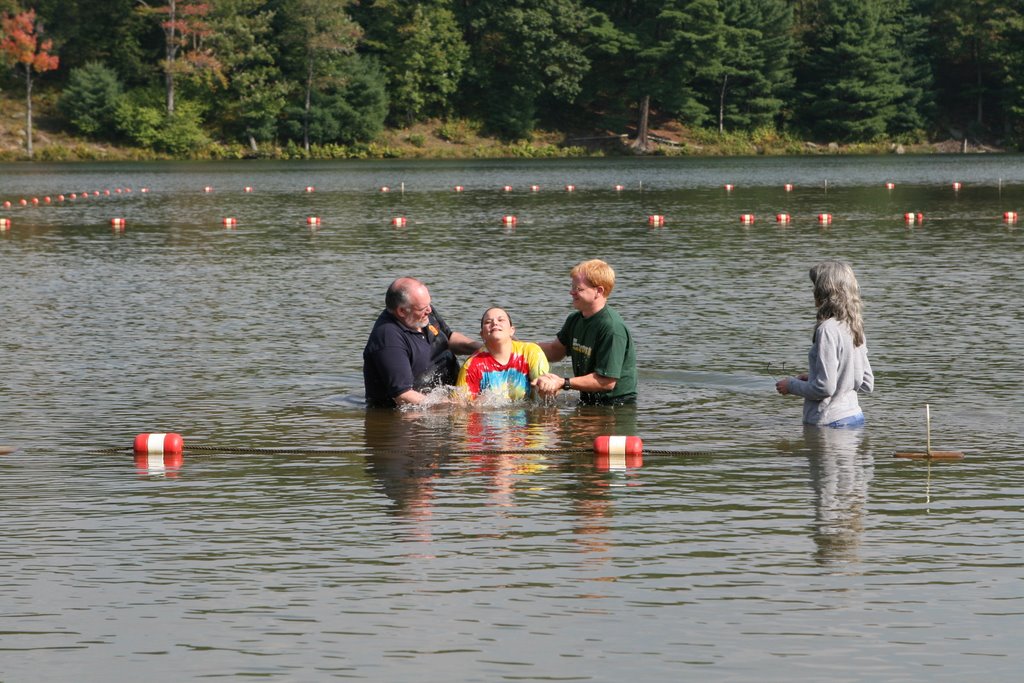 people from six different United Methodist churches watching from the shore of Glendale Lake, Michele was baptized on August 18, 2001. And on September 17, 2006, with the help of Pastor Seth McClymonds and some 40 people from the Reynoldsville United Methodist Church watching on the banks of the Parker Dam resevoir, Sarah was baptized. Each girl publicly affirmed her relationship with Jesus Christ as her Lord and proclaimed that she was turning her back on evil in order to live her life for Christ.
But, as proud as I've been of my girls, there was more going on at their baptism than just their commitment. There was more than just saying the words and then baptizing them by immersing them in the waters of those two lakes.
As United Methodists we teach how baptism and communion are called "sacraments" because they are the two things that Jesus Christ instructed us to go do. We do a lot of things in the church, but these two are commands from Christ Himself. So part of what was going on on those two occasions at those two lakes was simply a matter of obedience. Jesus said that we were to do it, so we did it.
The greatest part of our understanding of baptism, however, is that it is one of the ways we know that God uses to pour out His grace on people. Baptism is a physical symbol that gives us a "picture" of God's acceptance of us through His Son Jesus and symbolizes the way that God showered us with his grace. That's why United Methodists don't re-baptize. Since baptism is a picture of what GOD did, then why would we then picture Him as having to do it over? It's not like God is in Heaven saying: "Oops... I guess that one's baptism didn't take. I must have messed up my aim the first time... the grace didn't stick. I'd better get them baptized again and try to get them with my grace this time." Jesus Christ, God's Son, paid the price of our salvation once, and it was good for all time. We NEVER need another sacrifice to satisfy God. Nor do we ever need a second (or third or tenth) baptism, no matter how many times we might mess up. Because baptism's not about us and what we've done... It's about what HE does... and what HE did.
It's this dimension of God pouring out His grace on the one being baptized that has helped convince the Church through the centuries of the appropriateness of baptizing babies and children. We were able to accept Christ even though we don't personally remember His crucifixion or His resurrection. But by faith, we "remember." So too, baptism, done at any age is valid and acceptable, even if you cannot remember the historic event of being in the waters of baptism.
The specific act of being baptized, whether as an infant, a child, or as an adult, is a reflection of God's work... and our work is to live life in remembrance of that baptism and the work that God did.
Another part of our understanding of baptism is centered in the ancient baptismal rituals of the early church, which focused on the welcoming of someone new into the community of the people of God called "Christians." Baptism, in a sense, is partly an "initiation rite" that identifies the baptized one as part of the Christian group, similar to how circumcision of a baby Jewish boy identified him as a part of the Jewish community of faith (even though the baby boy will never remember the act of circumcision). That's another reason why United Methodists, and the early church, included infants in baptism. We baptize babies, in part, as a "welcome to the family" event where the parents and the congregation dedicate themselves to helping the baptized ones grow in the knowledge of the Christian faith so that they may be introduced to Jesus Christ and then, hopefully, one day accept Him as their Savior and Lord as well.
One more thing happens in baptism: the congregation renews their commitment to Christ and to living out their faith individually and corporately as a congregation. They promise the baptized one that we, the church, are going to be there for them to help them walk the faith walk and to look to Christ throughout their lives. This is why in United Methodism we don't need to specifically have "godparents" in baptism; the whole congregation makes a vow to God that we together will take on the role of godparents.
How many times have we been in the service of baptism, and not understood? Or worse, have not taken seriously the vow to "nurture" these ones we are welcoming to the community?
Maybe, in the words of our Wesleyan tradition, it's time to "remember our baptism" once again.
Saturday, September 30, 2006
UnTied Methodists
I visit a lot of other churches.
In my role as a pastor in the United Methodist Church, I am required to fulfill three assignments:
1. the Bishop has appointed me to help lead a particular congregation of United Methodists, in word, in sacrament, in order, and in service…
2. the Bishop has appointed me to be a voice of unity, and a caring presence, representing Jesus Christ in the local community to which I’ve been assigned, and
3. the Bishop has appointed me to be an active part of the Methodist connection; in the district, the conference, and even the world.
It is in those last two capacities that I get to visit other churches.... Not on Sunday morning of course, but I’m there for meetings, visits, times of prayer, hymn sings, and district and community events.
Whenever I’m in a different church, whether United Methodist or not, I try to walk away with a handful of their handouts... to see how they do things so that we can learn some of the things that work well elsewhere.
In one of those churches a few years back, not a United Methodist church, I came across two rackfuls of literature located prominently by their main entrance that, I supposed, were chocked full of their most important tenets. I expected to find tracts about salvation and faith in Christ. Instead, I found very pointed brochures about how wrong people were who didn’t believe the same way they did... including several references in various places about why United Methodists were not only misled and confused, but we’re probably not even Christian.
The reasons cited by the authors of those brochures highlighted the facts that United Methodists have commercials running advertising that we have “open hearts, open minds and open doors.” That’s true. Supposedly that means that we’re TOO open... TOO embracing of those that aren’t acceptable... because of our open policy of ecumenical work... trying to work together with those Catholics and those Episcopalians and those Presbyterians and those... those... those... others.
Interestingly enough,isn't that the very same accusation that the Pharisees leveled against Jesus...? He was hanging out with the wrong people!
As I continued to read, the brochures cited the ultimate evidence that our denomination is in error: we actually let the discussion of homosexuality come up in our legislative meetings. And that, according to what I read that day, is proof of our evilness.
Of course they didn’t mention that every single time the issues of ordaining homosexuals or marrying homosexuals has ever come up, it has ALWAYS been soundly voted down.
The other argument I read about pointed to the fact that we United Methodists weren’t really together on the important issues... and pointed to our stands on homosexuality, baptism, abortion, the death penalty, and such as proofs.
What those authors were saying, in effect, was that they were right... and they would be the greatest in the kingdom of God (and perhaps the ONLY ones in the kingdom of God).
That’s not really a new argument is it?
Jesus’ disciples, in Mark 9 and again in Luke 9, were doing the same things. Who would be God’s favorites? Who REALLY held the spiritual keys? Who would be IN, while everyone else would be OUT?
We read in Luke 9:46-48: An argument started among the disciples as to which of them would be the greatest. Jesus, knowing their thoughts, took a little child and had him stand beside him. Then he said to them, "Whoever welcomes this little child in my name welcomes me; and whoever welcomes me welcomes the one who sent me. For he who is least among you all—he is the greatest."
This Scripture passage reminds us of two major principles of following Jesus Christ.
1. The greatest in the kingdom is identified as the one who welcomes in the children...
AND
2. The greatest in the kingdom is identified as the one who serves everyone else around them.
As United Methodists, we take those two principles seriously...
We believe that one of our main priorities needs to be welcoming in the children...Those who are young and innocent in age and those, I believe, who are young and innocent in faith... and remember... the children are the ones who don’t know any better yet... Sometimes they do wrong things or go about things the wrong way… and it’s expected.
That’s part of the emphasis we have in our denomination on Sunday schools, junior church, and nurseries. United Methodists try to reach out to children and make them welcome in the presence of the church and her Lord Jesus Christ. To introduce them to Christ and then help nurture them as they grow in faith.
Secondly, one of our main priorities in this denomination is serving others... And thus you see United Methodist hospitals, prison ministries, hunger programs, soup kitchens, mission outreaches, relief efforts, elderly homes, and even working hand-in-hand with others who don’t believe like we do in order to improve people’s lives. We even spend time and money trying to be an advocate for peace and for those who are denied justice... we try to serve our fellow humans... regardless of their beliefs.
But read the next verse...
Luke 9: 49-50 reads: "Master," said John, "we saw a man driving out demons in your name and we tried to stop him, because he is not one of us."
"Do not stop him," Jesus said, "for whoever is not against you is for you."
Mark 9: 38-41 says it like this... "Teacher," said John, "we saw a man driving out demons in your name and we told him to stop, because he was not one of us." "Do not stop him," Jesus said. "No one who does a miracle in my name can in the next moment say anything bad about me, for whoever is not against us is for us. I tell you the truth, anyone who gives you a cup of water in my name because you belong to Christ will certainly not lose his reward.
In these two passages, we find Jesus telling us what to do when we are confronting a situation where another group, that isn’t exactly like us, is trying to minister in Jesus’ name...
We let them be... Because if they are ministering in Jesus’ name, then we’re on the same side... Even if an immature disciple like John calls us names or claims that we’re not real followers of Christ.
That is one of the undergirding, although often unmentioned, foundations of Methodism.
We recognize that what you believe about the king or the president, about marriage or homosexuality, about baptism or communion, isn’t nearly as important as to whether or not you know Jesus Christ.
We look to passages like Acts 16:31... “Believe on the Lord Jesus Christ and you shall be saved...” and passages like First John 5:1... “Everyone who believes that Jesus is the Christ is born of God...”
Notice it doesn’t say, ‘If you are baptized the right way, you’ll be saved’ or ‘If you hold the same theological understanding of communion or do communion the right way, then you’ll be saved.’ Nor does it say ‘If you follow the Bible exactly and do all it says to do then you’ll be saved.’ It doesn’t even say ‘You have to agree with one another on issues like abortion and homosexuality and drinking and gambling, then you’ll be saved.’
What DOES it say?
“Believe on the Lord Jesus Christ and you will be saved...”
Period.
We United Methodists are joined together by our belief that the Bible tells us that you come to salvation by a belief in Christ... That’s what ties us together in Methodism... That’s how we can be called UNITED Methodists.
And we also believe that you come to Christ like the song says: “Just as I am.”
And Jesus, will work on you from there on the things he wants to work on in your life...
And that’s why there’s SO much room in our church for so many people who don’t believe exactly like you and me... I recognize that Christ hasn’t perfected me yet, and I’m still a work in progress, and I’M allowed in the church, therefore someone else who calls Jesus ‘LORD’ but hasn’t been perfected yet, and doesn’t yet understand the truths that we understand, can fit in the Christian church just as easily...
And that’s why we don’t print brochures and tracts calling other churches names or claiming that we’re the right one ourselves.
Let's thank God for the UNTIED nature of our church… for the room we have for those who aren’t perfected yet… because in such a church there is room for you and me!
Let’s thank God for the UNITED nature of our church… that all those who believe in Jesus can come just the way they are and be welcomed into our church life… where we’ll pray for, commune with, and love one another as we all seek to grow and mature in Christ.
I think this is especially important as we celebrate World Communion Sunday this weekend... At least as United Methodists, we invite EVERYONE that knows Jesus Christ as their Lord and Savior to join us in this act of obediance, this act of unity, this declaration that knowing Jesus Christ is the ONLY way we can be saved and the ONLY criterion needed to determine whether or not you are welcome in our church... or in the kingdom of God....
In my role as a pastor in the United Methodist Church, I am required to fulfill three assignments:
1. the Bishop has appointed me to help lead a particular congregation of United Methodists, in word, in sacrament, in order, and in service…
2. the Bishop has appointed me to be a voice of unity, and a caring presence, representing Jesus Christ in the local community to which I’ve been assigned, and
3. the Bishop has appointed me to be an active part of the Methodist connection; in the district, the conference, and even the world.
It is in those last two capacities that I get to visit other churches.... Not on Sunday morning of course, but I’m there for meetings, visits, times of prayer, hymn sings, and district and community events.
Whenever I’m in a different church, whether United Methodist or not, I try to walk away with a handful of their handouts... to see how they do things so that we can learn some of the things that work well elsewhere.
In one of those churches a few years back, not a United Methodist church, I came across two rackfuls of literature located prominently by their main entrance that, I supposed, were chocked full of their most important tenets. I expected to find tracts about salvation and faith in Christ. Instead, I found very pointed brochures about how wrong people were who didn’t believe the same way they did... including several references in various places about why United Methodists were not only misled and confused, but we’re probably not even Christian.
The reasons cited by the authors of those brochures highlighted the facts that United Methodists have commercials running advertising that we have “open hearts, open minds and open doors.” That’s true. Supposedly that means that we’re TOO open... TOO embracing of those that aren’t acceptable... because of our open policy of ecumenical work... trying to work together with those Catholics and those Episcopalians and those Presbyterians and those... those... those... others.
Interestingly enough,isn't that the very same accusation that the Pharisees leveled against Jesus...? He was hanging out with the wrong people!
As I continued to read, the brochures cited the ultimate evidence that our denomination is in error: we actually let the discussion of homosexuality come up in our legislative meetings. And that, according to what I read that day, is proof of our evilness.
Of course they didn’t mention that every single time the issues of ordaining homosexuals or marrying homosexuals has ever come up, it has ALWAYS been soundly voted down.
The other argument I read about pointed to the fact that we United Methodists weren’t really together on the important issues... and pointed to our stands on homosexuality, baptism, abortion, the death penalty, and such as proofs.
What those authors were saying, in effect, was that they were right... and they would be the greatest in the kingdom of God (and perhaps the ONLY ones in the kingdom of God).
That’s not really a new argument is it?
Jesus’ disciples, in Mark 9 and again in Luke 9, were doing the same things. Who would be God’s favorites? Who REALLY held the spiritual keys? Who would be IN, while everyone else would be OUT?
We read in Luke 9:46-48: An argument started among the disciples as to which of them would be the greatest. Jesus, knowing their thoughts, took a little child and had him stand beside him. Then he said to them, "Whoever welcomes this little child in my name welcomes me; and whoever welcomes me welcomes the one who sent me. For he who is least among you all—he is the greatest."
This Scripture passage reminds us of two major principles of following Jesus Christ.
1. The greatest in the kingdom is identified as the one who welcomes in the children...
AND
2. The greatest in the kingdom is identified as the one who serves everyone else around them.
As United Methodists, we take those two principles seriously...
We believe that one of our main priorities needs to be welcoming in the children...Those who are young and innocent in age and those, I believe, who are young and innocent in faith... and remember... the children are the ones who don’t know any better yet... Sometimes they do wrong things or go about things the wrong way… and it’s expected.
That’s part of the emphasis we have in our denomination on Sunday schools, junior church, and nurseries. United Methodists try to reach out to children and make them welcome in the presence of the church and her Lord Jesus Christ. To introduce them to Christ and then help nurture them as they grow in faith.
Secondly, one of our main priorities in this denomination is serving others... And thus you see United Methodist hospitals, prison ministries, hunger programs, soup kitchens, mission outreaches, relief efforts, elderly homes, and even working hand-in-hand with others who don’t believe like we do in order to improve people’s lives. We even spend time and money trying to be an advocate for peace and for those who are denied justice... we try to serve our fellow humans... regardless of their beliefs.
But read the next verse...
Luke 9: 49-50 reads: "Master," said John, "we saw a man driving out demons in your name and we tried to stop him, because he is not one of us."
"Do not stop him," Jesus said, "for whoever is not against you is for you."
Mark 9: 38-41 says it like this... "Teacher," said John, "we saw a man driving out demons in your name and we told him to stop, because he was not one of us." "Do not stop him," Jesus said. "No one who does a miracle in my name can in the next moment say anything bad about me, for whoever is not against us is for us. I tell you the truth, anyone who gives you a cup of water in my name because you belong to Christ will certainly not lose his reward.
In these two passages, we find Jesus telling us what to do when we are confronting a situation where another group, that isn’t exactly like us, is trying to minister in Jesus’ name...
We let them be... Because if they are ministering in Jesus’ name, then we’re on the same side... Even if an immature disciple like John calls us names or claims that we’re not real followers of Christ.
That is one of the undergirding, although often unmentioned, foundations of Methodism.
We recognize that what you believe about the king or the president, about marriage or homosexuality, about baptism or communion, isn’t nearly as important as to whether or not you know Jesus Christ.
We look to passages like Acts 16:31... “Believe on the Lord Jesus Christ and you shall be saved...” and passages like First John 5:1... “Everyone who believes that Jesus is the Christ is born of God...”
Notice it doesn’t say, ‘If you are baptized the right way, you’ll be saved’ or ‘If you hold the same theological understanding of communion or do communion the right way, then you’ll be saved.’ Nor does it say ‘If you follow the Bible exactly and do all it says to do then you’ll be saved.’ It doesn’t even say ‘You have to agree with one another on issues like abortion and homosexuality and drinking and gambling, then you’ll be saved.’
What DOES it say?
“Believe on the Lord Jesus Christ and you will be saved...”
Period.
We United Methodists are joined together by our belief that the Bible tells us that you come to salvation by a belief in Christ... That’s what ties us together in Methodism... That’s how we can be called UNITED Methodists.
And we also believe that you come to Christ like the song says: “Just as I am.”
And Jesus, will work on you from there on the things he wants to work on in your life...
And that’s why there’s SO much room in our church for so many people who don’t believe exactly like you and me... I recognize that Christ hasn’t perfected me yet, and I’m still a work in progress, and I’M allowed in the church, therefore someone else who calls Jesus ‘LORD’ but hasn’t been perfected yet, and doesn’t yet understand the truths that we understand, can fit in the Christian church just as easily...
And that’s why we don’t print brochures and tracts calling other churches names or claiming that we’re the right one ourselves.
Let's thank God for the UNTIED nature of our church… for the room we have for those who aren’t perfected yet… because in such a church there is room for you and me!
Let’s thank God for the UNITED nature of our church… that all those who believe in Jesus can come just the way they are and be welcomed into our church life… where we’ll pray for, commune with, and love one another as we all seek to grow and mature in Christ.
I think this is especially important as we celebrate World Communion Sunday this weekend... At least as United Methodists, we invite EVERYONE that knows Jesus Christ as their Lord and Savior to join us in this act of obediance, this act of unity, this declaration that knowing Jesus Christ is the ONLY way we can be saved and the ONLY criterion needed to determine whether or not you are welcome in our church... or in the kingdom of God....
--adapted from sermon for October 1, 2006, by Dayton D. Mix
Subscribe to:
Posts (Atom)